
The Cage Is Open
Reflections on reading Annie Ernaux

The problem with writing personal essays for me is that I always end up writing about something shameful or embarrassing, even when I try to begin with another subject. This essay, for example, was supposed to be about my trajectory with Ernaux’s books, but before I got to her other books, I’d already ventured elsewhere, toward my own shame. One of my early poems writes of “shame in girl form / which was shame’s first form” and I guess I am not done with it.
What’s integral to my love for Annie Ernaux, and another favorite writer, Elena Ferrante, is the honesty with which they write about shame. Ernaux writes that “there is this need I have to write something that puts me in danger, like a cellar door that opens and must be entered, come what may.”
Ernaux and Ferrante were the first writers who made me feel fully seen in a book. In Ferrante, I felt present all over the place: in her depiction of female friendship, in the familial environment, in her protagonist’s competition and drive, insecurity and doubt, and in the maneuverings of her mind. At some point I want to write about how the My Brilliant Friend books are anti-fascist—but aren’t seen this way because they reflect the perspective of women.
After I discovered Ferrante, my previous beloved books paled slightly. Ferrante combines two distinctive kinds of lack: economic and emotional, and it was important for me to see how those two deprivations worked on each other, and especially how they existed internally where much of what women experience and think is lived: I’d lived a large portion of my life in my head, silent, but churning intensely on the inside.
In 2022, during the throes of Covid (when I had a devouring crush), Annie Ernaux was awarded the Nobel Prize. I had not read her since 1992 in Paris when I spent a junior semester abroad and rented a single room on Rue Blomet in the 14th arrondissement. My host was a British writer who lived with his teenage French daughter. She was still in high school and I was a junior in college, but perhaps due to differences in maturation between American teenagers and French teenagers, she and I hit it off immediately and became good friends. Like me she was a reader, and one day she handed me La Place by Annie Ernaux. I took it to bed with me and didn’t get out of bed until it was finished. I was struck by so many things that spring afternoon of 1992: the simple diction, the force of a feminine voice, the depiction of class through the eyes of a daughter. I had never read anything like Ernaux before. In my study abroad program we were reading Barthes, Perec, Céline, and Sartre. In contrast, Ernaux was startling easy to read—but somewhere along the way I’d been taught that easiness and clarity meant you were not a serious writer. She was entirely herself and she was clearly digging into her experience to make her own sense of it.
I followed up La Place with Une Femme, then put them back on the shelf for three decades. When she won the Nobel and I decided to read her again, her oeuvre had grown enormously. I began with Getting Lost, translated by Alison Strayer. Strayer has a feel for the emotional depth, diction, and energy of her voice. Getting Lost is about an obsessive affair. The setting of the book remains almost exclusively in Ernaux’s apartment where she is either having sex with her obsession or else thinking about when she will see her obsession again. I then read A Simple Passion, which is a meditation on that same love affair. By then, I’d fallen into a kind of trance with her narrative and it chafed against my own obsessive crush. Her voice has an overpowering, hypnotic power. The world of it is all-encompassing and I felt relief when I’d finished it.
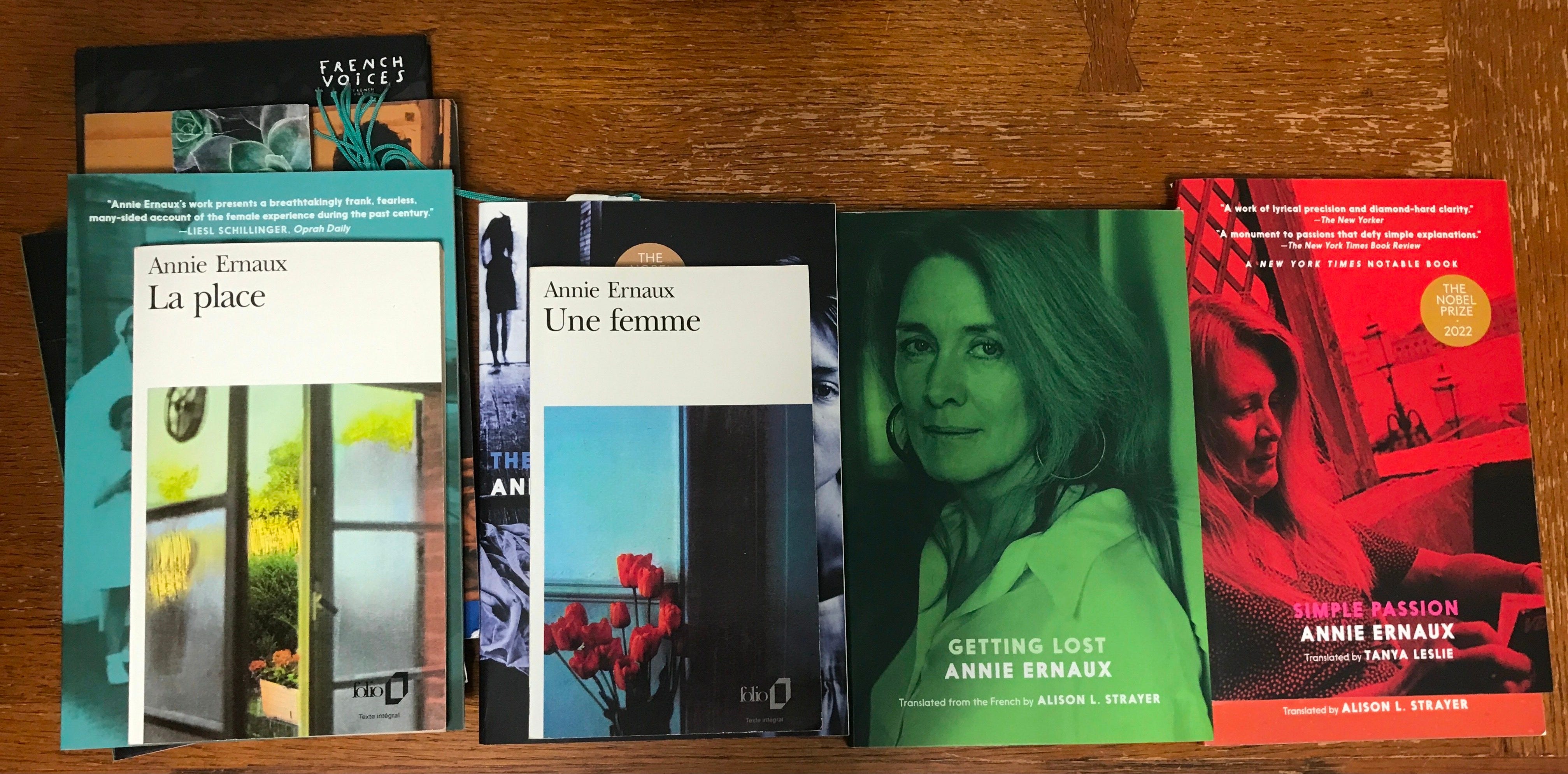
Like many of her books, Getting Lost is written as a journal in fragments, a form that leans toward a certain kind of truth-hunting. The fragments stop and start, pursuing what pulses and resonates. She does not waste time, but moves where the electricity is, and you can feel it:
Sunshine, everything is blue and gold and sweet. Birds chirp and, abruptly,
the sadness of adolescence is upon me. Someday, someone should probably
say how close a woman feels to adolescence between the ages of forty-eight
and fifty-two. Same expectations, same desires, but you’re heading into winter
instead of summer.
When I began reading her again I was forty-eight years old. I too had an obsessive crush that had taken over my brain like a drug and plunged me into a girlish insecurity. Now I understand the link between these crushes and my own low self-esteem (this kind of crush is sometimes referred to as a limerence—but that is a more recent realization). “Someday someone should say how close these years feel to adolescence.” I wish I could ask Annie Ernaux why that resemblance exists. I sense that our answers would be different, but I don’t know.
I talked about Getting Lost and Ernaux’s love affair so frequently to my husband that he started making Ernaux jokes.
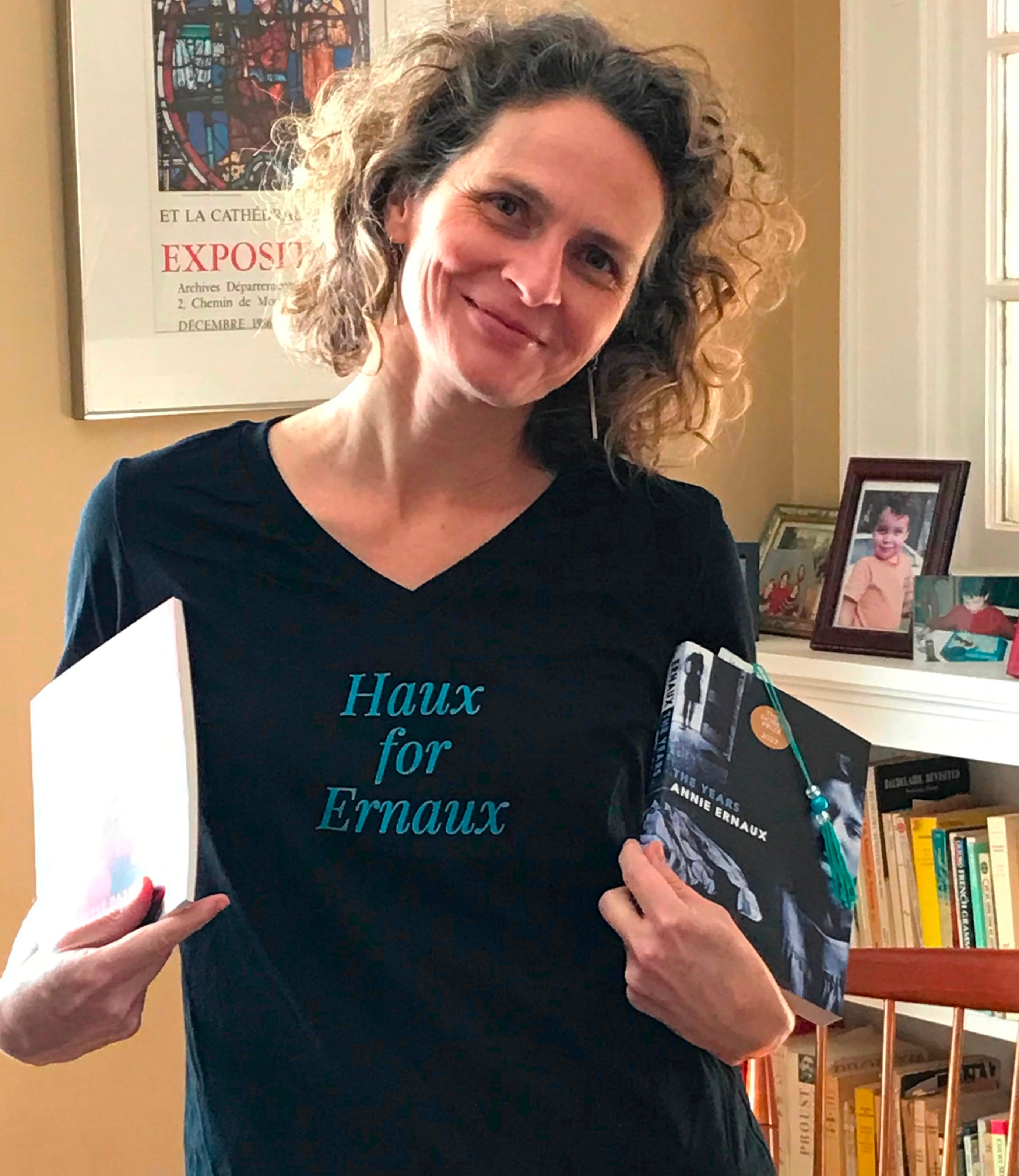
“If I made you a “hos for Ernaux” t-shirt would you wear it?”
“Only if you spell it haux so it looks French,” I answered. Haux is a geographic place but it’s also a homophone for “haut” (high).
My husband goes through multiple ridiculous hypotheticals in a week, (What if I gave you this? What if this happened? What if you showed up and said X?) but he did actually give me a “Haux for Ernaux” t-shirt on Christmas.
Last night I was staring at my husband who lay naked as he was falling asleep in the lamplight and I remarked that he looked like a painting. I tried to pull up the name of a comparable painting but nothing came to mind and it occurred to me that rarely do we gaze at a gorgeous man in art through the eyes of a woman painter. Rarely is female desire expressed as we feel it. My crush was so intense, I saved a slip of paper my crush had written his name on, folded it up, and carried it in my wallet for three years. Ernaux writes of her lover that “Everything about him was precious to me—his eyes, his mouth, his penis, his childhood memories, his voice, and the decisive way he took hold of things.” She saves a glass because he had drunk from it.
Ten years ago I wrote to poet Alice Notley and asked her why she’d said in an interview that there was no distinction between the conscious and unconscious and she said that she’d written so much that it had all come to the surface, there was no difference between the two.
For years I believed that freedom meant thinking or behaving in certain ways. I am now certain that nothing is more liberating than bringing forth everything from the depths where shame and dust cling to it.
I know that I am more free than Annie Ernaux is/was, simply by virtue of the year I was born. Still, I’ve inherited my own palimpsest of that script of self-abandonment. At the end of her affair, in pain and alone, Ernaux says, “I live outside men—I mean, outside the male realm—and it’s as if I were completely outside the world. Every day I have to create a schedule all over again, and convince myself to write.”
For so long, being seen by a man could bring me into the world of men, which felt, when I was growing up, like the world itself. To be cast out by a man was to be cast out of existence. “Do you know you exist?” poet astrologer Ariana Reines asked me last year after she’d gazed at my chart, and in the same encounter, in response to my poems, she said, “You’ve put yourself in a cage.”
“But,” she said earnestly, “The cage is open.”
I devoured each Ernaux book. Her books allowed me to breathe. Annihilation is too strong a word, I’m ashamed to use it, but I often annihilated my own thoughts and shoved my feelings away. The poetry book that I wrote during this time period, Feral (coming in 2027!), is my first poetry book that owes a greater debt to prose writers (Ernaux and Ferrante) than to any poet. Feral is not about desire or obsession, but it does bring forth buried experiences that made me ashamed to take up space in the world.
Love this post! And I want a Haux for Ernaux shirt too:)
Such a gorgeous piece, as honest as Ernaux. And I love that t-shirt. Please do write more about reading.